
News
Quest for affordable housing in a changing real estate market

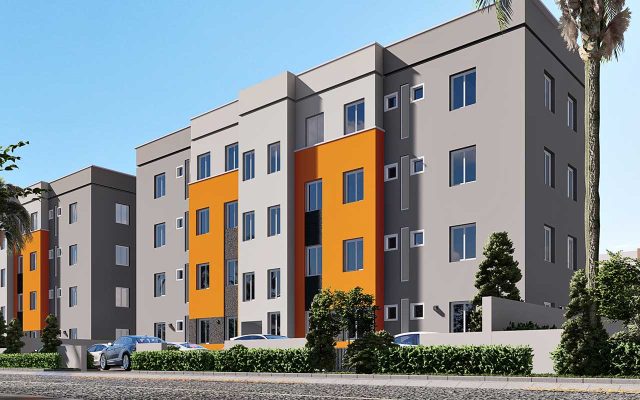
Quest for affordable housing in a changing real estate market
Developers and builders are actively adapting to the evolving real estate market by embracing innovative strategies and responding to emerging trends
As global real estate markets face shifting dynamics from economic pressures to evolving consumer needs, builders are rethinking their strategies to stay afloat and remain competitive.
In recent years, rising inflation, interest rate fluctuations, and increased construction costs have forced developers to reconsider traditional models. The CBN’s monetary policy, particularly the monetary policy rate (MPR), about 27.5 per cent, makes lending unattractive. But rather than slow down, many are innovating.
The fluctuating forex rates have also created high inflation on building materials, which inevitably are being passed to buyers.
The situation has created pockets of private sector estate developers, especially in the urban areas where the housing deficit is pronounced, like in Lagos, Abuja, Port Harcourt and Kano.
and Epe axis in Lagos. In these places, two and three-bedroom flats are selling between N50 – N80 million.
There is also a growing trend of shared apartments, where instead of the usual bungalows in a plot, developers have resorted to smaller apartments such as one or two-bedroom flats that would sell between N50-100 million, making it affordable for the middle class to live in a middle-class environment even though they don’t get the luxury of space and privacy in a compound.
Also, developers have moved outside the traditional cities like Lagos, Abuja, and Port Harcourt market into other state capitals to buy and sell plots of land under site and service scheme at a price considered affordable to the mass market.
On the larger scale at the government level, housing is still witnessing the usual lack of willpower by successive governments, which has continued to increase the supposedly housing deficit across the country.
Environmental concerns and a growing demand for affordable housing are prompting a shift toward greener and more cost-effective construction. Developers are prioritising eco-friendly designs and energy-efficient technologies to meet the growing demand for sustainable living.
construction costs and fluctuating access to financing have pushed many builders to phase projects more cautiously or pursue public-private partnerships.
Tightening building regulations and zoning laws are also reshaping project designs. Builders now engage more with policymakers to ensure compliance and predict future trends.
As the real estate landscape continues to evolve, experts and developers said builders who adapt quickly—with a focus on innovation, sustainability, and efficiency—are most likely to thrive in the market.
In his assessment, the Executive Secretary, Association of Housing Corporation of Nigeria (AHCN), Mr Toye Eniola, said, “This fluctuation in forex market dissuades developers from going for foreign loans as local banks are not ready to give out long-term loans for development; and if they do at high interest rate of over 30 per cent.
According to him, “No developer can lend at this rate to develop and break even as cost of the end product will be on top of the roof, which potential buyers would find difficult to afford.
He said the effect of this is a slow and snail-like development across various sites across the country. “There are rarely new developments,” he said. “This is seriously affecting the growth of the real estate industry as many are struggling to survive; large and mass developments are gradually going out of fashion as developers now develop on need-based and off-takers down-payment.”
Eniola explained that the current situation mostly affects the low and medium income. “This segment of the market ought to be taken care of by the government through housing corporations, but unfortunately, many of the state housing corporations are not getting the needed support from their governments.
“The solution lies in government going back to basics – embarking on social housing through state housing corporations to arrest the rising housing deficit. The government needs to provide infrastructure and support housing corporations to secure facilities for development and subsidise rental or purchasing cost to assist buyers or occupants,” he added.
A private sector practitioner and professional builder, Chucks Omeife, said one has had to think outside the box to cope with the prevailing economic situation, which is unfriendly.
Omeife, a past president of the Nigeria Institute of Building (NIOB), said, “The normal area where patronage is expected has been hijacked by our politicians for obvious reasons; hence, survival in the real estate sector demands critical and all-inclusive thinking.
However, he said opportunities still exist where professionals can depend for some level of survival such as Joint Venture development, Public Private Partnership (PPP), Build Operate and Transfer (BOT) and Renovate Operate and Transfer (ROT).
Omeife, who is the Managing Director of Build Consult Ltd, said, “While the problem of housing provision has been with us, no serious effort has been put in place by successive government to address this issue due to lack of will power and vision to see housing as an economic development indicator and a measure of economic growth.
“The current regime of astronomical prices of building materials is a major factor affecting the real estate development. The fact that most building materials, especially finished components, are imported and tied to the unstable foreign exchange rate is a big blow to the real estate sector.
“Cost of delivering project has skyrocketed that it is almost double if not triple in some cases. This is one major issue confronting the real estate sector today, and it is not looking as if it will be resolved soon,” he said.
Quest for affordable housing in a changing real estate market
A prototype of the Federal Ministry of Housing and Urban Development’s proposed Hope Cities project.
Developers and builders are actively adapting to the evolving real estate market by embracing innovative strategies and responding to emerging trends, CHINEDUM UWAEGBULAM reports.
As global real estate markets face shifting dynamics from economic pressures to evolving consumer needs, builders are rethinking their strategies to stay afloat and remain competitive.
In recent years, rising inflation, interest rate fluctuations, and increased construction costs have forced developers to reconsider traditional models. The CBN’s monetary policy, particularly the monetary policy rate (MPR), about 27.5 per cent, makes lending unattractive. But rather than slow down, many are innovating.
The fluctuating forex rates have also created high inflation on building materials, which inevitably are being passed to buyers.
The situation has created pockets of private sector estate developers, especially in the urban areas where the housing deficit is pronounced, like in Lagos, Abuja, Port Harcourt and Kano.
The Guardian learnt that new town developments are now ongoing outside the metropolitan city, where land cost is low (affordable). For instance, most developers are looking towards the Abijo, Ibeju-lekki and Epe axis in Lagos. In these places, two and three-bedroom flats are selling between N50 – N80 million.
There is also a growing trend of shared apartments, where instead of the usual bungalows in a plot, developers have resorted to smaller apartments such as one or two-bedroom flats that would sell between N50-100 million, making it affordable for the middle class to live in a middle-class environment even though they don’t get the luxury of space and privacy in a compound.
Also, developers have moved outside the traditional cities like Lagos, Abuja, and Port Harcourt market into other state capitals to buy and sell plots of land under site and service scheme at a price considered affordable to the mass market.
On the larger scale at the government level, housing is still witnessing the usual lack of willpower by successive governments, which has continued to increase the supposedly housing deficit across the country.
Environmental concerns and a growing demand for affordable housing are prompting a shift toward greener and more cost-effective construction. Developers are prioritising eco-friendly designs and energy-efficient technologies to meet the growing demand for sustainable living.
Besides, the COVID-19 pandemic has changed how people live and work, leading to an uptick in mixed-use projects that blend residential, commercial, and recreational spaces. These communities, often designed to reduce commuting and increase convenience, are particularly popular in fast-growing cities.
The Guardian gathered that rising construction costs and fluctuating access to financing have pushed many builders to phase projects more cautiously or pursue public-private partnerships.
Tightening building regulations and zoning laws are also reshaping project designs. Builders now engage more with policymakers to ensure compliance and predict future trends.
As the real estate landscape continues to evolve, experts and developers said builders who adapt quickly—with a focus on innovation, sustainability, and efficiency—are most likely to thrive in the market.
In his assessment, the Executive Secretary, Association of Housing Corporation of Nigeria (AHCN), Mr Toye Eniola, said, “This fluctuation in forex market dissuades developers from going for foreign loans as local banks are not ready to give out long-term loans for development; and if they do at high interest rate of over 30 per cent.
According to him, “No developer can lend at this rate to develop and break even as cost of the end product will be on top of the roof, which potential buyers would find difficult to afford.
He said the effect of this is a slow and snail-like development across various sites across the country. “There are rarely new developments,” he said. “This is seriously affecting the growth of the real estate industry as many are struggling to survive; large and mass developments are gradually going out of fashion as developers now develop on need-based and off-takers down-payment.”
Eniola explained that the current situation mostly affects the low and medium income. “This segment of the market ought to be taken care of by the government through housing corporations, but unfortunately, many of the state housing corporations are not getting the needed support from their governments.
“The solution lies in government going back to basics – embarking on social housing through state housing corporations to arrest the rising housing deficit. The government needs to provide infrastructure and support housing corporations to secure facilities for development and subsidise rental or purchasing cost to assist buyers or occupants,” he added.
A private sector practitioner and professional builder, Chucks Omeife, said one has had to think outside the box to cope with the prevailing economic situation, which is unfriendly.
Related News
CBN targets reduction in transaction costs with PAPSS
Naira redesign: Court strikes out N1b suit against Buhari, Emefiele, CBN
How diaspora investments are reshaping real estate market
Omeife, a past president of the Nigeria Institute of Building (NIOB), said, “The normal area where patronage is expected has been hijacked by our politicians for obvious reasons; hence, survival in the real estate sector demands critical and all-inclusive thinking.
However, he said opportunities still exist where professionals can depend for some level of survival such as Joint Venture development, Public Private Partnership (PPP), Build Operate and Transfer (BOT) and Renovate Operate and Transfer (ROT).
Omeife, who is the Managing Director of Build Consult Ltd, said, “While the problem of housing provision has been with us, no serious effort has been put in place by successive government to address this issue due to lack of will power and vision to see housing as an economic development indicator and a measure of economic growth.
“The current regime of astronomical prices of building materials is a major factor affecting the real estate development. The fact that most building materials, especially finished components, are imported and tied to the unstable foreign exchange rate is a big blow to the real estate sector.
“Cost of delivering project has skyrocketed that it is almost double if not triple in some cases. This is one major issue confronting the real estate sector today, and it is not looking as if it will be resolved soon,” he said.
Omeife stressed that the housing situation is a complex issue and addressing it requires a multi-faceted approach that considers the prevailing economic situation.
He stated that the Nigerian economic data and indices do not always reflect the reality on the ground. While there is an obvious crunch in the Nigerian economy, the general outlook on the real estate situation is the opposite.
“The source of funding obviously should be a thing of interest to the government, but incidentally, the real estate sector has been seen to be a haven for money laundering and corruption. It is becoming confusing seeing the high level of activities in the real estate sector despite the downturn in the economy.”
Omeife called on the government to allocate more resources to housing development and infrastructure and to intensify collaboration with the private sector to increase housing supply and affordability.
Besides, he said the government should provide accessible financing options for low-income earners while offering subsidies and incentives to developers to build affordable housing.
National Housing Programme, and the activities of the finance institutions in the housing sector.”
The Managing Director of Property Vaults Limited, Mr Andy Morkah, agreed that the cost of construction has tripled in some areas, making it expensive to build. “The direct impact of this high cost is a high selling price of the finished properties, thereby making an average property unaffordable for the middle class.”
However, he said the market has witnessed some growth attributable to mass market site-and-service schemes and upper-class developments. Another factor Morkah. mentioned that drove growth in the volume of sales is the impact of realtors.
“The industry has witnessed the establishment of several organised realtors groups whose driving factor is the mouth-watering commissions paid by developers. Members of these groups and other independent freelancers have been bullish in the persuasion of buyers for sales.
He linked the issues in the sector to weak demand for finished properties, lack of affordable and long-term mortgage facilities, a dearth of professionalism amongst real estate developers and poor regulation. “The mortgage industry lacks the right liquidity and pricing to service the mortgage needs of the population.”
Morkah, who is a property developer, disclosed that there has been low yearly sales turnover for most real estate companies doing only house development in the last two years, which led to the high level of abandoned sites, as some developers are unable to continue due to lack of funds.
Despite the development, the real estate industry has expanded significantly as one of the major contributors to the nation’s Gross Domestic Product (GDP) because of the activities of old and stable developers coupled with new entrants at the various state capitals selling sites and service estates.
He emphasised that the current state of the Nigerian real estate market requires a drastic reduction in the general price level, and this can majorly be driven by intentional government economic policies that will improve balance of payment indices towards reversing the exchange rate, among other factors.
He advocates government policies that will intentionally reduce the cost of land acquisition and construction such that allocation of land to developers should be transparent and affordable. “At this period, processing of land titles and building approvals should be at minimal cost to balance already existing high cost of construction.
“Government should invest massively on infrastructure in new areas to encourage developers. The government should remove politics from the allocation of mass housing projects, engage professional developers or partner with them,” he said.

Adron Group Chairman Celebrates Business Icon Otunba Muraina Banjoko at 65 (more…)
News
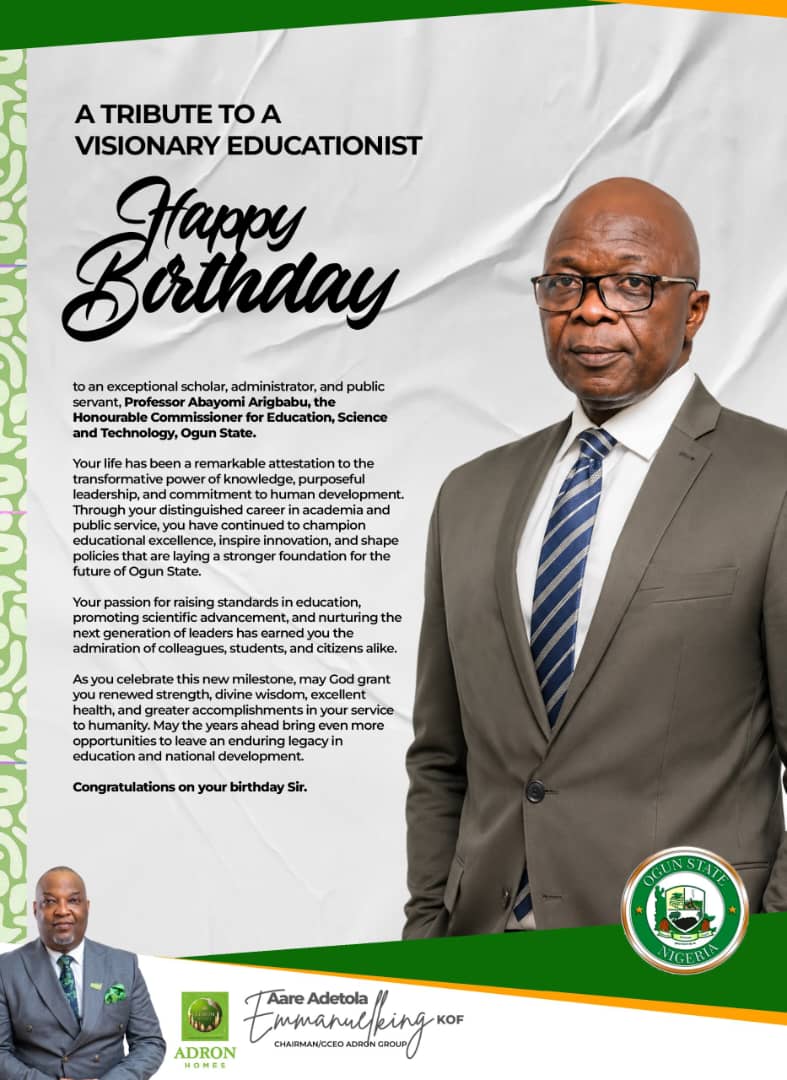
Aare Adetola Emmanuelking Hails Prof. Abayomi Arigbabu’s Impact on Education as He Marks Birthday
Aare Adetola Emmanuelking Hails Prof. Abayomi Arigbabu’s Impact on Education as He Marks Birthday
The Chairman/GCEO of Adron Group, Aare Adetola Emmanuelking, has paid glowing tribute to the Honourable Commissioner for Education, Science and Technology, Ogun State, Professor Abayomi Arigbabu, describing him as one of the foremost architects of educational transformation whose leadership continues to redefine learning and human capital development in the Gateway State.
In a heartfelt birthday message, the renowned real estate entrepreneur commended Professor Arigbabu for his exceptional blend of scholarship, administrative excellence, and visionary public service, noting that his stewardship of the education sector has continued to inspire confidence in the future of education in Ogun State.
According to Aare Adetola Emmanuelking, Professor Arigbabu has distinguished himself as an education reformer whose policies and programmes have consistently advanced academic excellence, strengthened institutional standards, promoted innovation, and positioned education as a strategic driver of sustainable development.
“Professor Abayomi Arigbabu exemplifies the ideals of visionary leadership. His dedication to improving educational outcomes and empowering the next generation through quality learning continues to leave an indelible mark on Ogun State and Nigeria as a whole. His legacy is one of impact, excellence, and selfless service,” he stated.
The Adron Group Chairman further acknowledged the Commissioner’s commitment to building an education system that equips young people with the knowledge, skills, and values required to thrive in an increasingly dynamic world, describing his contributions as invaluable to the state’s development agenda.
As Professor Arigbabu marks another year, Aare Adetola Emmanuelking prayed for renewed strength, divine wisdom, robust health, and greater accomplishments, expressing confidence that the celebrant’s passion for educational advancement would continue to shape lives and inspire generations.
He wished the Commissioner a memorable birthday celebration and many more years of impactful service to Ogun State, Nigeria, and humanity.
News
RSS Makes History as Graduating Class of 2026 Marks Valedictory Service in First-of-Its-Kind University-Style Ceremony

RSS Makes History as Graduating Class of 2026 Marks Valedictory Service in First-of-Its-Kind University-Style Ceremony
Remo Secondary School (RSS) has made history with the graduation of its 2026 class in what is being described as a groundbreaking academic ceremony, as the prestigious public secondary school celebrated its graduating students in a university-themed graduation style.
The historic valedictory service, which brought together students, parents, teachers, school administrators, old students and distinguished guests, was marked by pomp, pageantry and an atmosphere of academic excellence, as graduating students appeared in full academic graduation gowns, caps and other traditional graduation regalia.
In a striking departure from conventional valedictory ceremonies typically held in public secondary schools, the school’s principals and teachers, as well as the National Executives of the Remo Secondary School Old Students’ Association (RSSOSA), also donned academic gowns, creating the atmosphere and grandeur of a university convocation.
The remarkable initiative transformed the valedictory service into a memorable graduation experience for the students and marked a significant milestone in the history of Remo Secondary School, Ogun State and, potentially, the Nigerian public school system.
The ceremony was not only a celebration of the completion of secondary education, but also a deliberate effort to instil in the graduating students a sense of pride, achievement and responsibility as they prepare to transition into higher education and the next phase of their lives.
Another major highlight of the ceremony was the presentation of awards to deserving students in recognition of outstanding morals, good character and exemplary conduct. The awards, which cut across various categories, celebrated students who distinguished themselves not only through academic pursuits, but also through positive character traits, discipline, responsibility and good morals.
In a further demonstration of its commitment to the future of the graduating students and the advancement of education, Hope Bridge Social Impact Foundation awarded full higher education scholarships to about 25 deserving students. The scholarship awards will support the beneficiaries in pursuing their tertiary education, providing them with an opportunity to further their academic aspirations and achieve their full potential.
Speaking at the ceremony, the President of the Remo Secondary School Old Students’ Association (RSSOSA), Sir Aare Adetola Emmanuelking KOF, congratulated the graduating class and commended the school management, teachers and parents for their roles in nurturing and guiding the students throughout their academic journey.
He further expressed appreciation to the Ogun State Government, ably led by the Executive Governor, His Excellency, Prince Dapo Abiodun, MFR, CON, for his administration’s commitment to transforming the education sector in the state.
He specifically acknowledged the Governor’s Yellow Revolution initiative, describing it as one of the notable interventions that has positively impacted the education sector and contributed to creating a more conducive environment for learning across public schools in Ogun State.
According to him, the Governor’s keen attention to education and the deliberate interventions of his administration have had a positive ripple effect that has extended to institutions such as Remo Secondary School, contributing to the school’s continued growth and development and helping to position it as a great institution.
Aare Adetola Emmanuelking also extended his appreciation to the Ogun State Commissioner for Education, Science and Technology, Prof. Abayomi Arigbabu, for his leadership and evident contributions to the advancement of education in the state.
The event further highlighted the strong bond between the school and its old students, with the presence and participation of the old students, demonstrating the association’s continued commitment to the development and advancement of the institution.
The innovative university-style graduation ceremony is expected to remain one of the most memorable moments in the history of the school, and could set a new standard for how graduating students are celebrated in public secondary schools across Ogun State and beyond.
For the graduating class of 2026, the occasion was a day of pride, gratitude and celebration, a day when they were not only bid farewell from secondary school, but were honoured and celebrated as graduates stepping confidently into the future.

-
 Real Estate Achievers Awards1 year ago
Real Estate Achievers Awards and Exhibition 2025
-

 Mortgage finance1 year ago
Comparing Nigerian Mortgage Structures to Global Standards mortgage
-

 News1 year ago
RERAPAN Celebrates Babatunde Adeyemo at 46
-
 Interviews2 years ago
Google hit with record EU fine over Shopping service
-
 Opinion2 years ago
All you need to know about penalty shootouts
-
News1 year ago
Real Estate Achievers Awards and Exhibition 2025 (REAA)
-
 Real Estate insurance2 years ago
The full story of Thailand’s extraordinary cave rescue
-
 Mortgage finance1 year ago
FG to seize mortgaged property of retirees over unpaid housing loans